CapaKraken
Resource & Capacity Planning for 3D Production Studios
Plan teams. Track chargeability. Forecast budgets. Staff smarter.








---
## About
CapaKraken is a full-stack resource planning and project staffing application built for 3D production environments -- VFX studios, animation houses, and automotive visualization teams. It replaces spreadsheet-based capacity planning with a real-time, multi-user web application that provides a single source of truth for who is working on what, when, and at what cost.
The application was designed from the ground up for the unique challenges of creative production: fluctuating team sizes, overlapping project phases, mixed chargeability models (client-billable vs. internal vs. BD), complex holiday calendars across multiple countries, and the need to forecast resource availability months in advance.
---
## Feature Overview
### Interactive Timeline
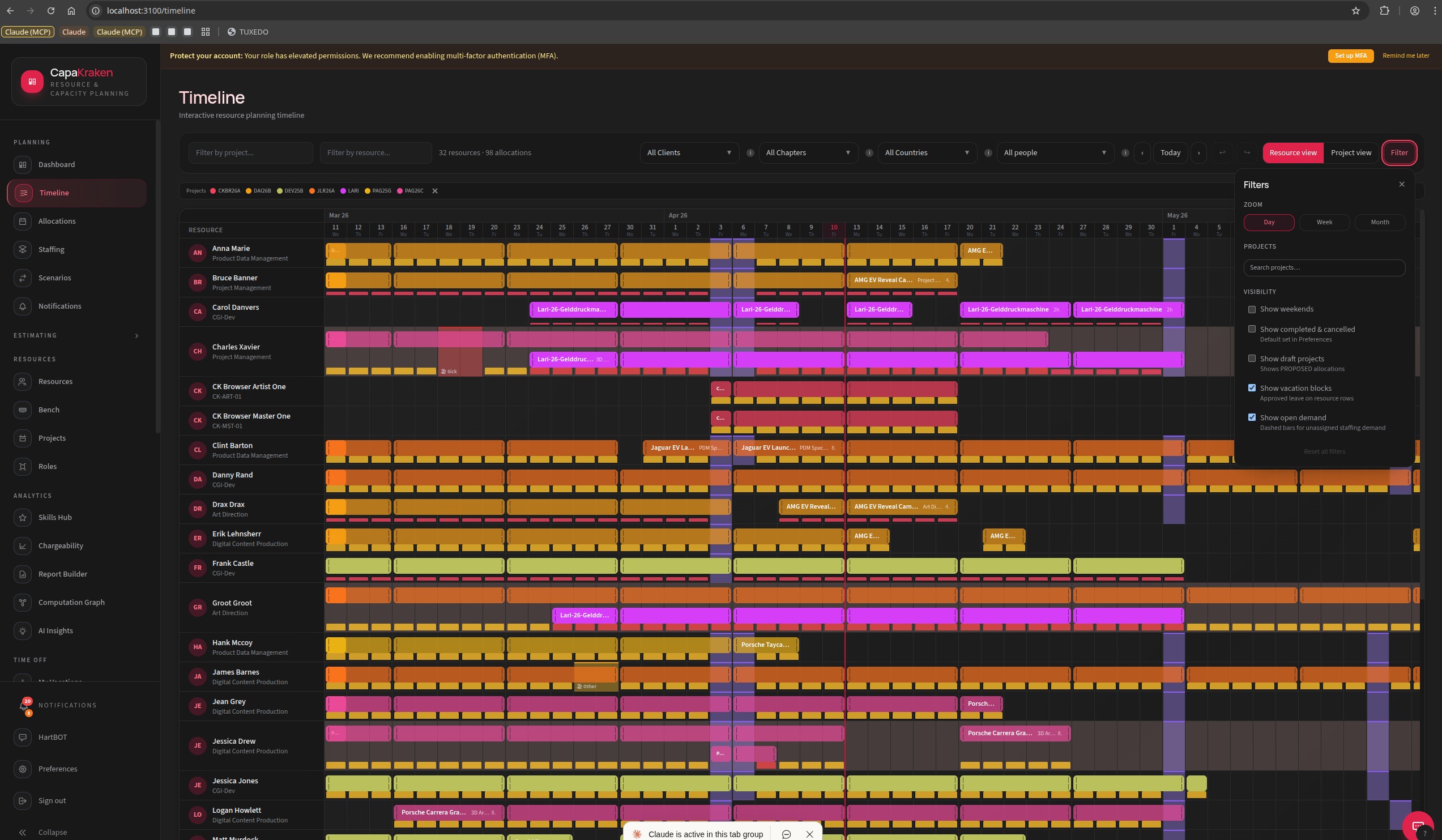
The timeline is the centerpiece of CapaKraken. It provides a visual, interactive view of all resource allocations across projects.
- **Resource View** -- see all allocations for each person, with color-coded project bars stacked in sub-lanes when they overlap
- **Project View** -- flip the perspective to see all resources assigned to each project
- **Zoom Levels** -- switch between day, week, and month granularity; the grid adapts automatically
- **Drag-and-Drop** -- click and drag on empty timeline cells to create new allocations; existing bars can be moved or resized
- **Heatmap Overlay** -- toggle a per-day utilization heatmap that colors cells from green (underbooked) through yellow to red (overbooked), with configurable color schemes
- **Vacation Integration** -- approved and pending vacations overlay as semi-transparent bars; public holidays are shown per-country with federal state and city awareness
- **Weekend Highlighting** -- weekend columns follow the configurable accent/brand color for instant visual orientation
- **Filters** -- filter by project, client, chapter, country, role, order type, and more; toggle visibility of completed/cancelled projects, draft projects, and vacation blocks
- **Overbooking Detection** -- days where a resource exceeds their available hours flash with a warning overlay
### Chargeability Forecasting
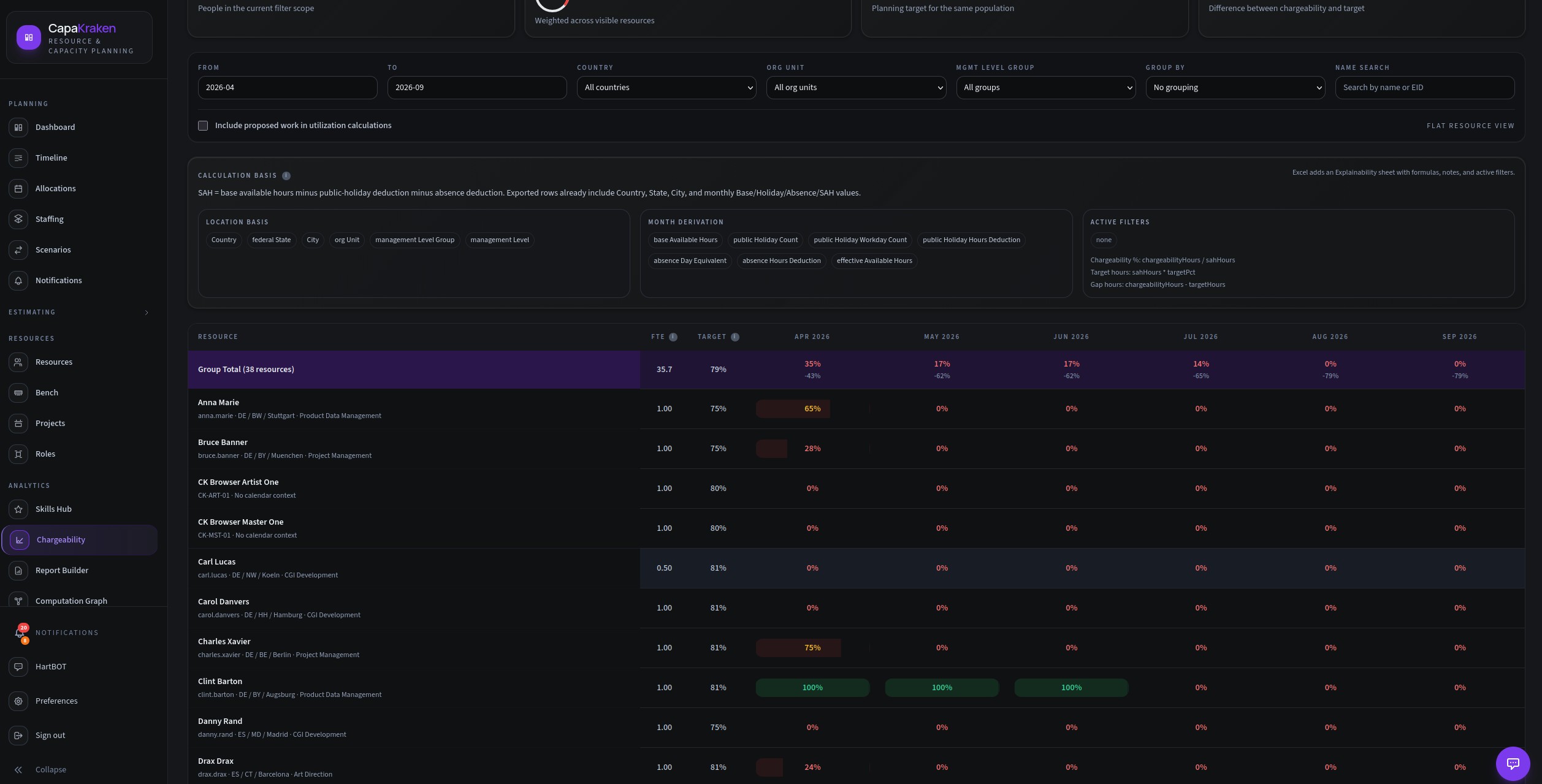
The chargeability module provides monthly forecasts comparing actual allocation against targets.
- **Standard Available Hours (SAH)** -- automatically calculated per resource, per month, accounting for weekends, public holidays (country/state/city-level), annual leave, sick days, and custom deductions
- **Holiday Deduction Rules** -- configurable per location: which holiday types to deduct, which calendars to apply, with a visual breakdown of gross days, holiday counts, and resulting net working days
- **Target Comparison** -- set chargeability targets at group or individual level; the report shows actual vs. target with color-coded variance
- **Drill-Down Grouping** -- group by chapter, role, management level, country, or custom dimensions
- **Active Filters** -- same powerful filter set as the timeline, applied consistently
- **Export** -- one-click Excel and CSV export with all visible data, formatting preserved
### Chargeability Overview
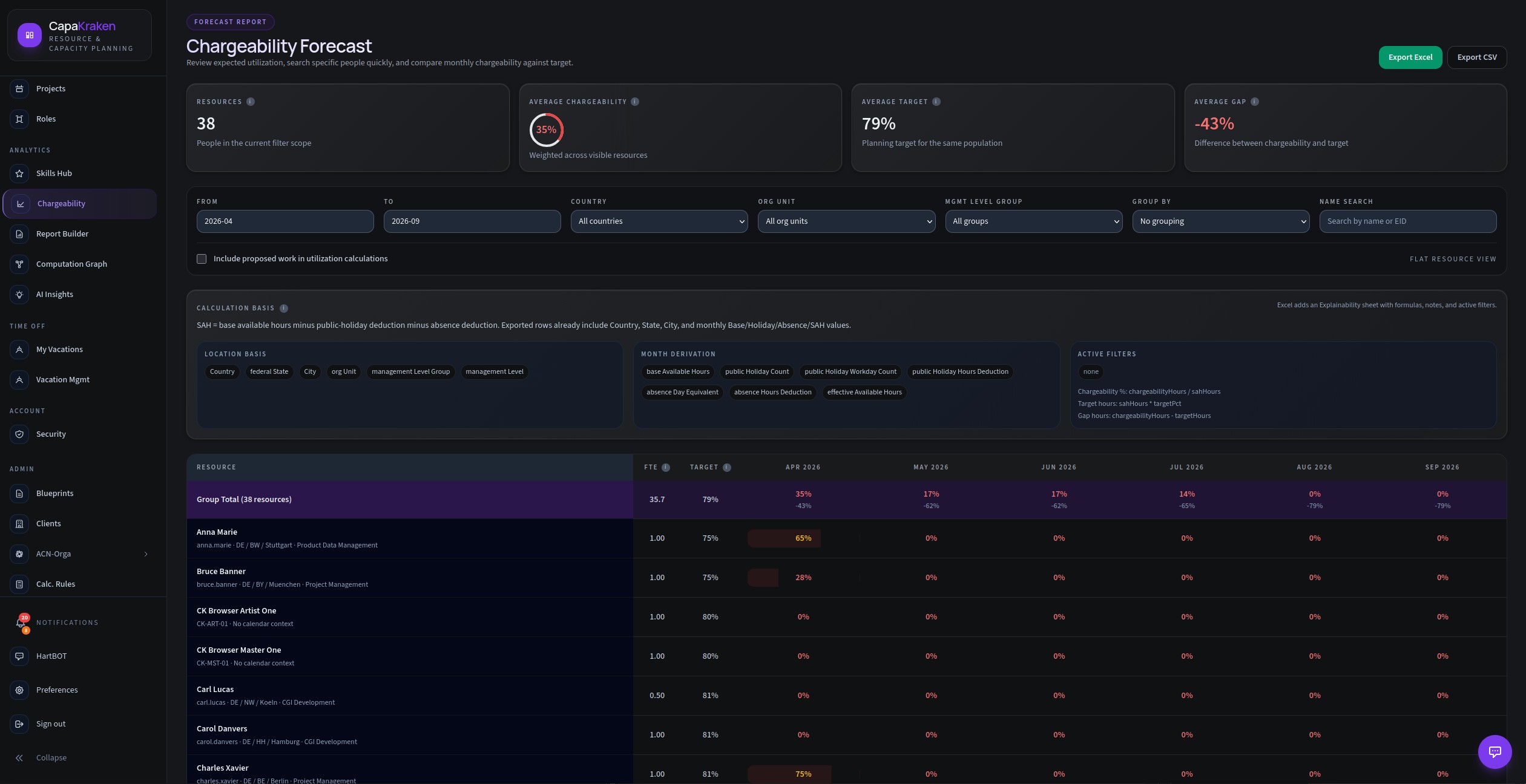
A high-level view showing per-resource utilization as a color-coded heatmap across months, making it easy to spot under- or over-utilized team members at a glance.
### Allocations
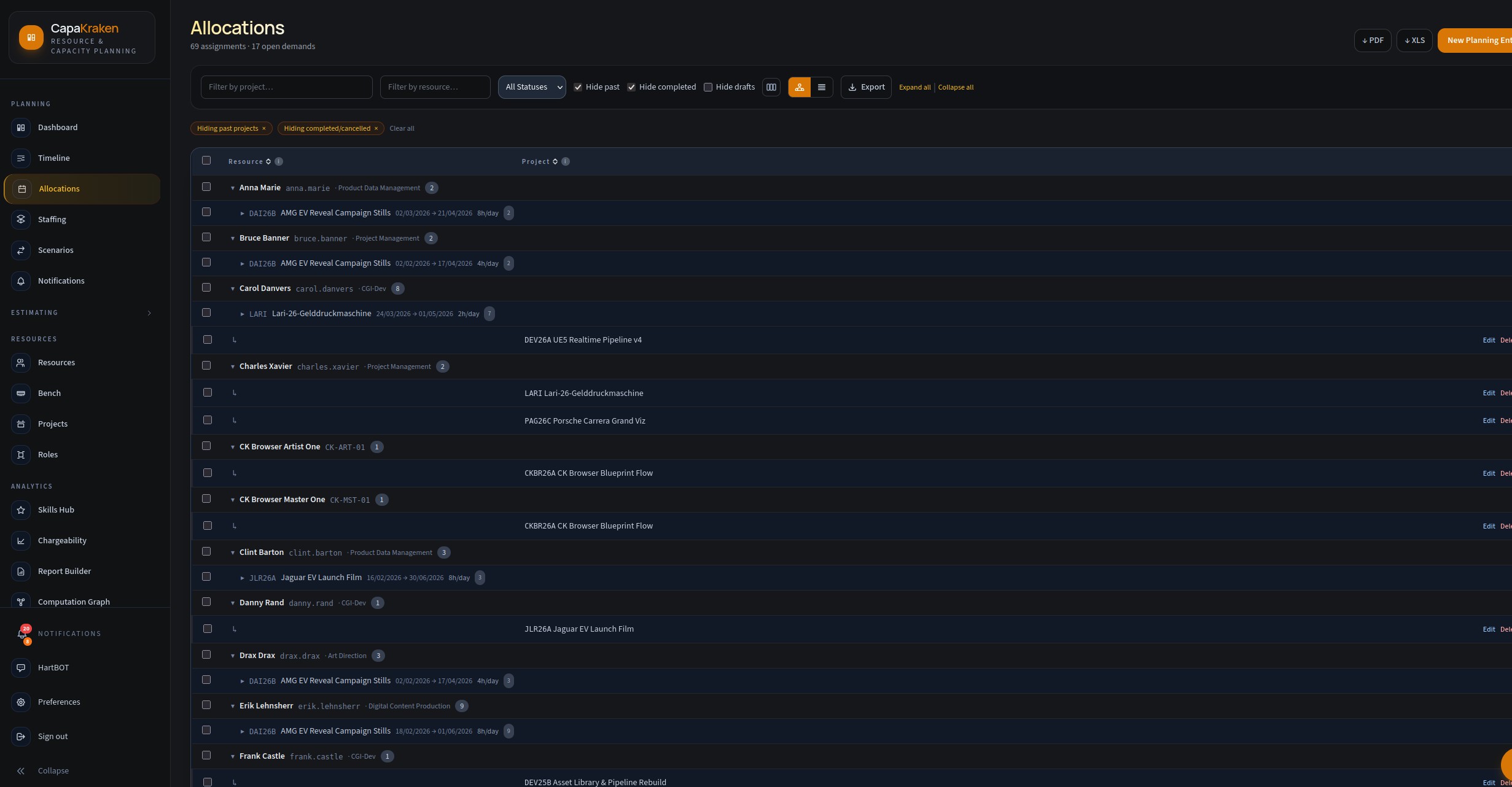
A structured list view of all allocations with:
- **Status Workflow** -- allocations move through Proposed, Confirmed, Active, Completed, and Cancelled states
- **Grouping** -- view by resource or by project, with expandable/collapsible groups
- **Inline Editing** -- quick-edit hours, dates, and status directly from the list
- **Bulk Operations** -- multi-select allocations for batch status changes or deletion
- **Data Density Toggle** -- switch between compact and detailed views; hide/show metadata columns
- **New Planning Entry** -- create allocations from a floating action button with project and resource pickers
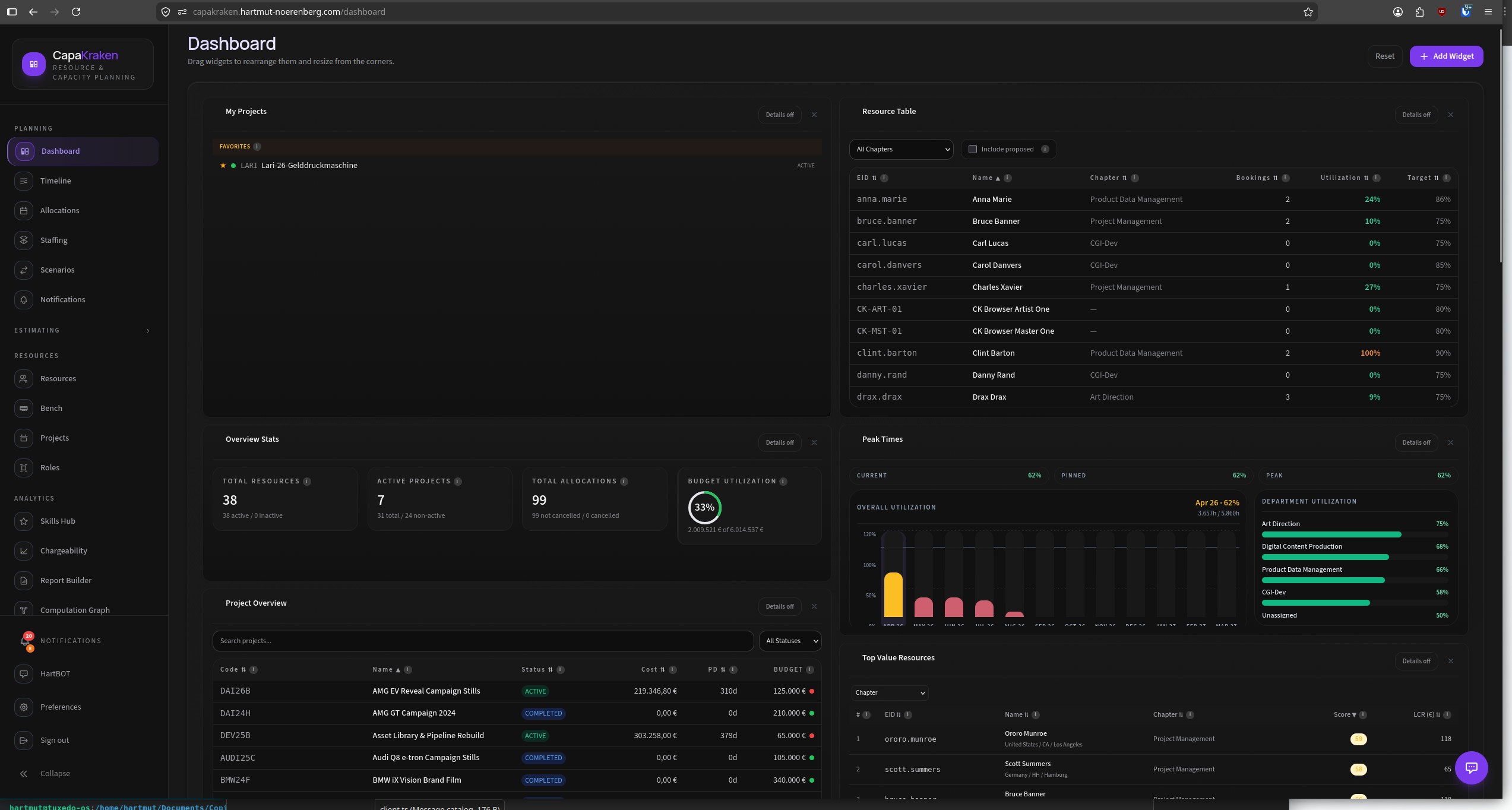
### Customizable Dashboards
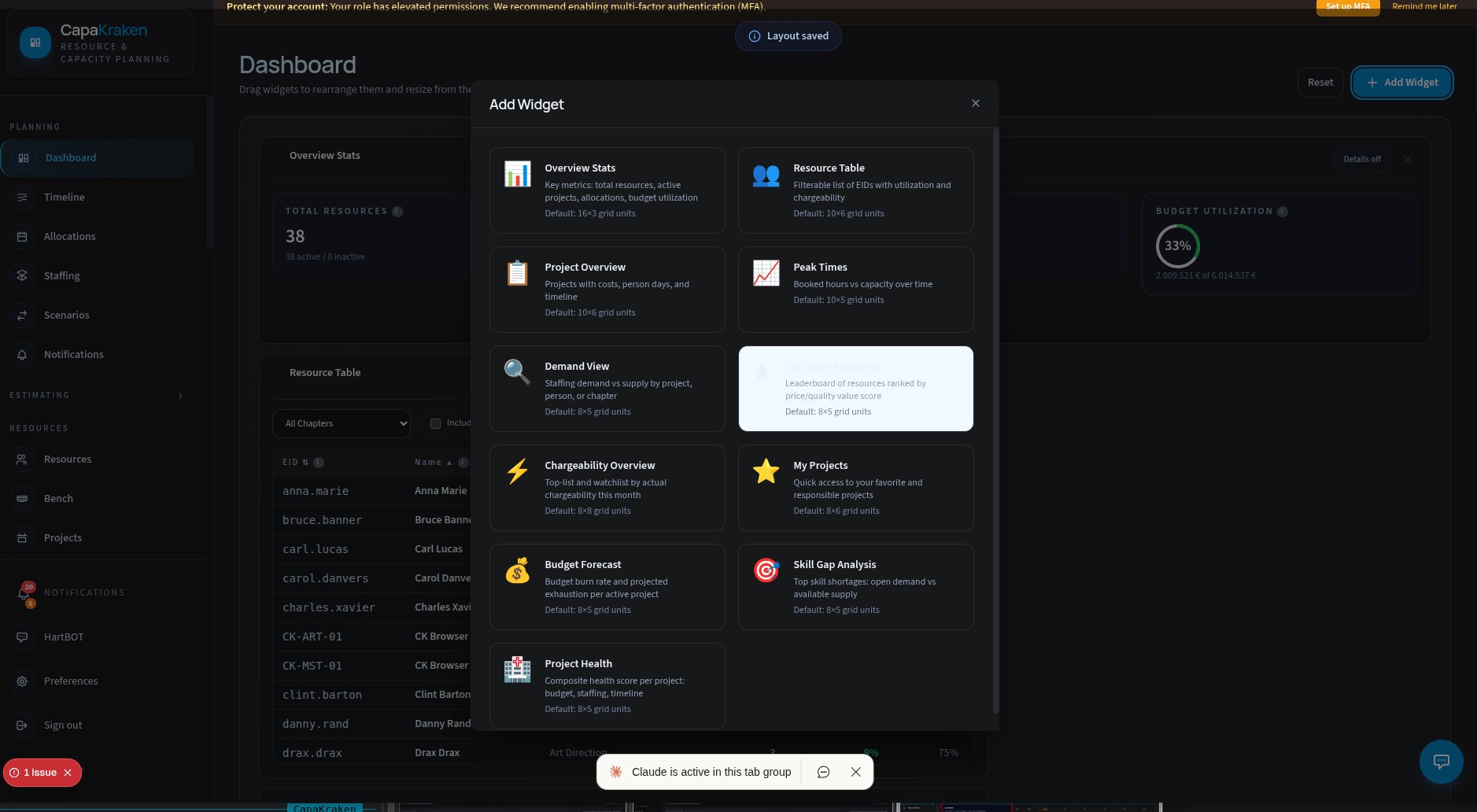
Each user gets a personal dashboard they can customize with drag-and-drop widgets:
| Widget | Description |
|--------|-------------|
| **Overview Stats** | Total resources, active projects, allocations, and budget utilization at a glance |
| **My Projects** | Quick access to projects where the current user is assigned or responsible |
| **Resource Table** | Filterable EID list with utilization percentages and chargeability indicators |
| **Project Overview** | All projects with cost, person days, and status badges |
| **Peak Times** | Bar chart showing booked hours vs. capacity over time, with department breakdown |
| **Demand View** | Staffing demand vs. supply by project, with unfilled headcount tracking |
| **Chargeability Overview** | Leaderboard of resources ranked by chargeability score |
| **Budget Forecast** | Budget burn rate and projected cost per active project |
| **Skill Gap Analysis** | Top skill shortages comparing open demand against available supply |
| **Project Health** | Composite health score per project (budget, staffing, timeline) |
Widgets are resizable, and the layout persists per user. An **Add Widget** catalog lets users browse available widgets with descriptions and default sizes.
### Estimating System
A full project estimation workflow:
- **Estimate Workspaces** -- create, version, and compare estimates with full CRUD
- **Scope Items** -- break down deliverables into line items with assumptions and constraints
- **Demand Lines** -- define required roles, hours, and rates per scope item
- **Rate Cards** -- client-specific rate cards with experience multipliers and shoring ratios (onshore/nearshore/offshore)
- **Version Control** -- save snapshots, compare versions side-by-side, and track what changed
- **Approval Workflow** -- submit estimates for approval; approved versions can be handed off to create actual project allocations
- **Planning Handoff** -- one-click conversion from approved estimate to live project allocations with resource assignment
### Staffing & Demand Management
- **Open Demand Tracking** -- projects can declare required roles and headcount; unfilled positions show as dashed bars on the timeline
- **AI-Assisted Matching** -- when filling demand, the system suggests best-fit resources based on skills, availability, cost, and location
- **Skill Gap Analysis** -- dashboard widget comparing aggregate demand against available supply, highlighting bottleneck roles
- **Demand-to-Assignment** -- convert demand entries into confirmed allocations with a guided workflow
### Scenario Planning
- **What-If Scenarios** -- create sandbox copies of the current allocation state
- **Simulation** -- add, move, or remove allocations in the scenario without affecting production data
- **Baseline Comparison** -- see what changed between the scenario and the current baseline
- **Apply or Discard** -- promote a scenario to production or delete it
### Admin & Configuration
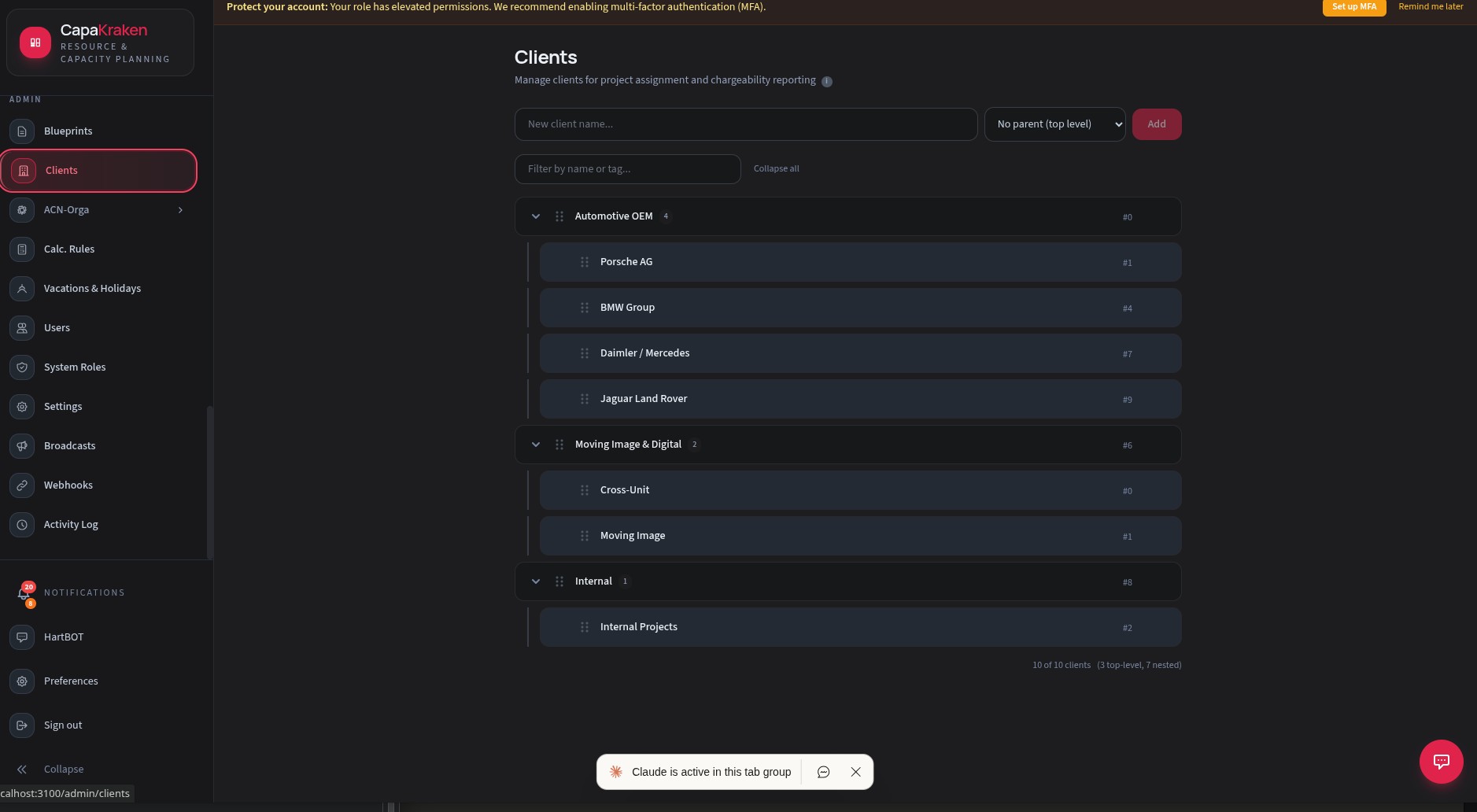
- **Client Hierarchy** -- nested client/chapter/sub-chapter tree with drag-and-drop reordering; clients scope chargeability and project assignment
- **Blueprints** -- define custom field schemas (text, number, select, date, etc.) that attach to projects or resources; field values are validated, searchable, and filterable
- **Roles & Management Levels** -- hierarchical role tree with cost rates; management levels for organizational reporting
- **Rate Cards** -- global and per-client rate tables with currency support
- **Vacations & Holidays** -- manage public holiday calendars per country/state/city; approve/reject leave requests; import calendars from external sources
- **Calculation Rules** -- configure SAH parameters, chargeability targets, and deduction policies
- **Users & Auth** -- invite users by email, Argon2 password hashing, optional TOTP two-factor authentication, role-based access control (Admin, Manager, Viewer, User)
- **Settings** -- SMTP configuration (also configurable via env vars), notification preferences, accent color theme
- **Broadcasts** -- send system-wide announcements to all users
- **Webhooks** -- configure outgoing webhook notifications for key events
- **Activity Log** -- audit trail of significant actions across the system
### Real-Time Collaboration
- **Server-Sent Events (SSE)** -- allocation changes, project updates, and notifications are pushed to all connected clients in real time via Redis pub/sub
- **Notification Center** -- in-app notification bell with unread count, grouped by category, with click-to-navigate
- **Optimistic Updates** -- UI reflects changes immediately while the server confirms in the background
### Theming
- **Dark Mode** -- full dark theme with CSS variable-based surface system; all components adapt automatically
- **Accent Colors** -- choose from multiple accent color presets (Sky, Indigo, Emerald, Rose, Amber, Violet) that flow through the entire UI: buttons, links, timeline highlights, charts, and badges
- **Responsive Layout** -- collapsible sidebar, adaptive grid layouts, mobile-aware touch interactions
---
## Tech Stack
| Layer | Technology | Purpose |
|-------|-----------|---------|
| **Frontend** | Next.js 15 (App Router), React 19 | Server components, streaming, file-based routing |
| **Styling** | Tailwind CSS v4 | Utility-first CSS with custom design tokens |
| **API** | tRPC v11 | End-to-end type-safe RPC between client and server |
| **Database** | PostgreSQL 16 via Prisma ORM | Relational data with JSONB for dynamic fields |
| **Auth** | Auth.js v5 | Session management, Argon2 passwords, TOTP MFA |
| **Realtime** | SSE + Redis pub/sub | Live updates without WebSocket complexity |
| **AI** | Azure OpenAI / Gemini | Staffing suggestions, skill profile generation |
| **Monorepo** | pnpm workspaces + Turborepo | Incremental builds, shared configs, dependency isolation |
| **Testing** | Vitest + Playwright | Unit tests (engine, shared) and E2E browser tests |
| **Containerization** | Docker Compose | Dev and production stacks with health checks |
### Monorepo Structure
```
capakraken/
|
+-- apps/
| +-- web/ Next.js 15 application (frontend + API routes)
| +-- src/
| +-- app/ App Router pages and layouts
| +-- components/ React components organized by domain
| +-- hooks/ Custom React hooks
| +-- lib/ Client utilities, formatters, constants
| +-- server/ Server-side auth, tRPC context
|
+-- packages/
| +-- shared/ Types, Zod schemas, constants (zero dependencies)
| +-- db/ Prisma schema, migrations, seed scripts
| +-- engine/ Pure calculation logic (SAH, chargeability, budget, allocation)
| +-- staffing/ AI-assisted staffing, capacity analysis, profile matching
| +-- application/ Use-case orchestration layer (business workflows)
| +-- api/ tRPC routers, procedures, middleware
| +-- ui/ Shared UI component library (planned)
|
+-- tooling/
| +-- docker/ Container entrypoint scripts
| +-- deploy/ Production deployment automation
| +-- eslint/ Shared ESLint configuration
| +-- typescript/ Shared tsconfig bases
|
+-- scripts/ Lifecycle scripts (start, stop, DB management)
+-- docs/ Product docs, architecture decisions, screenshots
```
### Architecture
```
+---------------------------------------------------------------+
| Browser (React 19) |
| Dashboard | Timeline | Allocations | Chargeability |
+------+-----+-----+------+-------+-------+--------+-----------+
| | | |
| tRPC (type-safe RPC over HTTP) |
| | | |
+------+-----------+---------------+----------------+-----------+
| Next.js 15 App Router |
| (Server Components + API Routes) |
+------+-----+-----+------+-------+-------+--------+-----------+
| | | |
+------+-----------+---------------+----------------+-----------+
| packages/api (tRPC v11) |
| allocation.* | project.* | chargeability.* | estimate.*|
+------+-----+---+-----+------+-------+-----------+-----------+
| | | |
+------+-----------+-------+ +----+----------------+-----------+
| packages/application | | packages/engine |
| (use-case orchestration) | | (pure calculations, no I/O) |
| - estimate workflows | | - SAH calculator |
| - dashboard aggregation | | - chargeability engine |
| - staffing use-cases | | - budget monitor |
+------+-------------------+ | - allocation calculator |
| +----+----------------------------+
| |
+------+---------------------------+----------------------------+
| packages/db (Prisma ORM) |
| schema.prisma | migrations | seed | queries |
+------+-------------------------------------------------------+
|
+------+-------------------------------------------------------+
| PostgreSQL 16 + Redis 7 |
+---------------------------------------------------------------+
```
---
## Getting Started
### Prerequisites
| Requirement | Minimum Version | Check |
|-------------|----------------|-------|
| **Node.js** | 20.x | `node --version` |
| **pnpm** | 9.x | `pnpm --version` |
| **Docker** | 24+ | `docker --version` |
| **Docker Compose** | v2 | `docker compose version` |
### 1. Clone and configure
```bash
git clone https://gitea.hartmut-noerenberg.com/Hartmut/plANARCHY.git capakraken
cd capakraken
```
Create your environment file:
```bash
cp .env.example .env
```
Edit `.env` and fill in the required values:
```bash
# Required -- generate with: openssl rand -base64 32
NEXTAUTH_SECRET=
# Required -- your app URL
NEXTAUTH_URL=http://localhost:3100
# Required for the pgAdmin web UI
PGADMIN_PASSWORD=admin
```
> **Note:** The database connection (`DATABASE_URL`), Redis, and SMTP (MailHog) are pre-configured for Docker Compose and work out of the box. See [`.env.example`](.env.example) for the full reference with all optional variables.
### 2. Start with Docker (recommended)
```bash
bash scripts/start.sh
```
This single command will:
1. Pull and start **PostgreSQL 16** and **Redis 7** containers
2. Build the application Docker image (first run: ~2 minutes)
3. Run **Prisma migrations** automatically against the database
4. Validate workspace exports and imports
5. Start the **Next.js dev server** with hot reload on port 3100
You'll see output like:
```
Starting CapaKraken...
Starting PostgreSQL + Redis...
Waiting for PostgreSQL...
Starting app container on port 3100...
Waiting for server (up to 90s)...
CapaKraken is running!
{
"status": "ok",
"database": "connected",
"redis": "connected"
}
URL: http://localhost:3100
```
### 3. Start without Docker (host-native)
If you prefer running Node.js directly on your machine:
```bash
# Install all workspace dependencies
pnpm install
# Start only the infrastructure via Docker
docker compose up -d postgres redis
# Generate the Prisma client and apply migrations
pnpm db:generate
pnpm db:migrate
# Start the Next.js dev server with hot reload
pnpm dev
```
### 4. Create your first user
1. Open **http://localhost:3100** in your browser
2. Click **Sign up** on the login page
3. Enter your name, email, and password
4. The first registered user is automatically granted **Admin** privileges
5. Explore the sidebar to discover all features
### 5. Load demo data (optional)
```bash
pnpm db:seed
```
This populates the database with sample clients, projects, resources, allocations, and roles so you can immediately explore all features without manual setup.
---
## Available Services
When running with Docker Compose, the following services are available:
| Service | URL | Purpose |
|---------|-----|---------|
| **CapaKraken App** | [localhost:3100](http://localhost:3100) | Main application |
| **MailHog** | [localhost:8025](http://localhost:8025) | Email testing UI -- catches all outgoing emails (invitations, password resets, notifications) |
| **pgAdmin** | [localhost:5050](http://localhost:5050) | Visual database administration |
| **PostgreSQL** | `localhost:5433` | Direct database access (user: `capakraken`, db: `capakraken`) |
| **Redis** | `localhost:6380` | Cache, rate limiting, and SSE pub/sub |
---
## Scripts Reference
### Application Lifecycle
| Command | Description |
|---------|-------------|
| `bash scripts/start.sh` | Start all services (PostgreSQL, Redis, app) |
| `bash scripts/stop.sh` | Stop all services gracefully |
| `bash scripts/restart.sh` | Full stop + start cycle |
### Development
| Command | Description |
|---------|-------------|
| `pnpm dev` | Start Next.js dev server with hot reload (host-native) |
| `pnpm build` | Production build (standalone output) |
| `pnpm lint` | Run ESLint across all packages |
| `pnpm format` | Format all files with Prettier |
| `pnpm test:unit` | Run unit tests via Vitest |
| `pnpm test:e2e` | Run end-to-end tests via Playwright |
| `pnpm typecheck` | TypeScript type checking across all packages |
| `pnpm check:architecture` | Verify architecture guardrails (import boundaries, etc.) |
### Database
| Command | Description |
|---------|-------------|
| `pnpm db:generate` | Regenerate Prisma client after schema changes |
| `pnpm db:migrate` | Create and apply new migrations |
| `pnpm db:push` | Push schema changes directly (no migration file) |
| `pnpm db:studio` | Open Prisma Studio (visual data browser) |
| `pnpm db:seed` | Seed the database with demo data |
| `pnpm db:doctor` | Run health checks on database state |
| `pnpm db:seed:export` | Export current DB state as a seed file |
| `pnpm db:seed:import` | Import a previously exported seed file |
---
## Production Deployment
CapaKraken ships with a production-ready Docker Compose stack and deployment automation.
### Quick Deploy
```bash
# Configure required secrets
export APP_IMAGE=ghcr.io/your-org/capakraken-app:latest
export MIGRATOR_IMAGE=ghcr.io/your-org/capakraken-migrator:latest
export POSTGRES_PASSWORD=$(openssl rand -hex 32)
export REDIS_PASSWORD=$(openssl rand -hex 32)
export NEXTAUTH_SECRET=$(openssl rand -base64 32)
# Deploy with readiness verification
bash tooling/deploy/deploy-compose.sh production
```
### Production Stack Features
- **Multi-stage Docker build** -- optimized standalone Next.js output (~150 MB image)
- **Sidecar migrator** -- runs Prisma migrations before the app starts, then exits
- **Redis authentication** -- password-protected with `--requirepass`
- **Health probes** -- `/api/health` (liveness) and `/api/ready` (readiness with DB + Redis checks)
- **Automatic rollback** -- deployment script verifies readiness; on failure, logs are captured for debugging
- **Environment separation** -- configure via `.env.production` and `deploy.env` files
- **Container registry** -- configurable via `DOCKER_REGISTRY` (defaults to `ghcr.io`)
---
## Environment Variables
See [`.env.example`](.env.example) for the complete reference with inline documentation. Summary of key variables:
| Variable | Required | Default | Description |
|----------|----------|---------|-------------|
| `NEXTAUTH_URL` | Yes | -- | Public URL of the application |
| `NEXTAUTH_SECRET` | Yes | -- | Secret for JWT signing and session encryption |
| `DATABASE_URL` | Yes | `localhost:5433` | PostgreSQL connection string |
| `REDIS_PASSWORD` | Prod | -- | Redis authentication password |
| `REDIS_URL` | No | `redis://redis:6379` | Redis connection (auto-configured in Docker) |
| `SMTP_HOST` | No | -- | SMTP server for email delivery |
| `SMTP_PORT` | No | `587` | SMTP port |
| `SMTP_FROM` | No | `noreply@capakraken.dev` | Sender address for outgoing emails |
| `AZURE_OPENAI_API_KEY` | No | -- | Enables AI-assisted staffing features |
| `GEMINI_API_KEY` | No | -- | Alternative AI provider |
| `LOG_LEVEL` | No | `info` | Logging verbosity (trace/debug/info/warn/error) |
| `CRON_SECRET` | No | -- | Authenticates scheduled job endpoints |
---
## Design Principles
| Principle | Implementation |
|-----------|---------------|
| **Money as integer cents** | All monetary values stored and calculated in cents to eliminate floating-point drift |
| **Strict TypeScript** | No `any` types, strict null checks, explicit Prisma casts at package boundaries |
| **Domain-driven packages** | Each bounded context (estimating, chargeability, staffing) lives in its own package with clear exports |
| **Pure engine logic** | Calculation packages have zero I/O dependencies -- they take data in and return results |
| **Real-time by default** | SSE pushes changes to all clients via Redis pub/sub; no polling |
| **Theme-aware UI** | CSS variable-based surface system with configurable accent colors and full dark mode |
| **Defensive data handling** | Nullable foreign keys handled explicitly; Prisma enums and JSONB cast at boundaries |
| **No speculative abstractions** | Build what's needed now; three similar lines beat a premature abstraction |
---
## Contributing
1. Create a feature branch from `main`
2. Follow the existing code style -- ESLint and Prettier enforce it automatically
3. Add unit tests for new business logic, especially in `packages/engine`
4. Run quality gates before submitting:
```bash
pnpm test:unit
pnpm --filter @capakraken/web exec tsc --noEmit
pnpm lint
pnpm check:architecture
```
5. Keep commits focused with descriptive messages
6. Open a pull request with a clear description of what changed and why
---
## License
Proprietary. All rights reserved.
---
Built with TypeScript, Next.js, and a lot of coffee.